by Peter Scott
October 15, 1960 – April 3, 2025
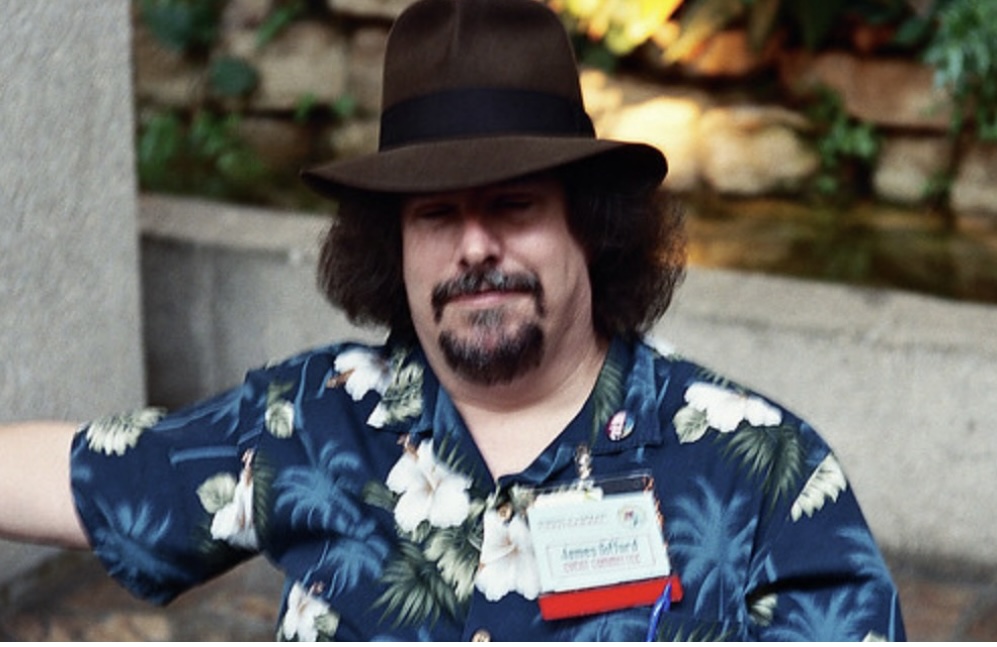
It is my sad duty to report the unexpected death of a luminary within the Heinleinsphere. Jim Gifford passed away at his Colorado home on April 3 of natural causes. The fandom pool we swim in would have been a puddle without his efforts, most notably his book Robert A. Heinlein: A Reader’s Companion (https://www.nitrosyncretic.com/nsp_title_raharc.php), a tour-de-force reference containing the New Heinlein Opus List (https://www.nitrosyncretic.com/rah/ftp/nhol.pdf), commonly just abbreviated ‘ARC’ and ‘NHOL’, and his soup-to-nuts management of the Heinlein Centennial Convention in 2007.
This is very difficult for me to write, for three reasons. The first is that we were close friends for over two decades, emailing nearly every day. We were philosophical BFFs. It is emotionally impossible for me to pen a clinical obituary.
The second reason is that it’s also technically impossible for me to pen a clinical obituary. There was so much to the man that I know lies outside my awareness, so much that you deserve to know, but of which I have only cursory details. I am a penguin shambling across the surface of the Gifford iceberg. We must crowdsource what we can. As much as posterity deserves a thorough and objective accounting of a man’s life, I know mine will be lacking on both counts.
The third reason is that I cannot write about Jim without being reminded of how much in his shadow my prose lies. His writing displayed a breathtaking command of language that would shame a national opinion columnist. And he exhibited this even in each everyday e-mail he wrote, many of which I kept as exhibits of the lost art of epistolography. Once I got worked up enough to ask him, “I want to get better at this writing thing; how do you do it so effortlessly?” His answer was that he had a sign over his desk reading ‘GLIB’, which was typical Jim compression of a reminder to not settle for that. The arrival of a message from him was a signal to stop everything else; those messages have inspired me to up my writing game on all fronts.
James Daniel Gifford was born in Sacramento, the youngest of four children, parents Robert and Dorothy. His siblings were Coe, Craig, and Robert, who is a professor in my town of Victoria, British Columbia. Bob says that “Jim was too smart for school, and went his own way,” attending but not completing some post-secondary education. He married twice, and had several biological and acquired children. He lived in California, then Connecticut, then Colorado before running out of states beginning with ‘C’. He had an affection for large dogs, and would invariably have to mute his microphone several times in a Zoom call because one was attacking some invading poltergeist. I am relieved to report that his canine dependents are taken care of.
Some of his early employment included installing the first ATMs, but it didn’t take long for him to gravitate towards the publishing field. At the age of 25 he wrote a highly technical book on automotive security systems, by which time he had at least 13 magazine articles published… in that same year.
In 2000 his landmark work Robert A. Heinlein: A Reader’s Companion was published – not, as some commentators expected, a biography, but the far more gruelling duty of cataloguing everything Heinlein wrote, down to individual letters, and setting them in context for the fan. To this end Jim devised the New Heinlein Opus notation system when Heinlein’s own index proved inadequate.
The sheer, doctoral dissertation-level detail grinding required was his hallmark. He could not dabble; whenever I heard he had taken an interest in a new topic he would have a monograph on it the next day, a website within a week, and a book draft within a month. These ran the gamut from consumerism to onomatology. The existing anti-consumption movements didn’t scratch his philosophical itch, so he started his own: Renegade Consumerism (https://renegadeconsumer.com/). He developed an interest in Frank Gilbreth, an obscure character mostly remembered by the semi-autobiographical novel Cheaper by the Dozen. Jim decided that he deserved to be far less obscure, and so naturally he researched the colorful Gilbreth family, approached the estate, created a website (https://thegilbreths.com/) and wrote a book, Cheaper by the Dozen at 75: A Reader’s Companion.
One day he sent me an email about a new interest. “I am looking for famous or well-known people in any field who changed or dropped their given names and are known primarily by the changed one.” People like (Stephen) Grover Cleveland and (Hiram) Ulysses Grant. Where nearly everyone else, on noting a few occurrences in that pattern, might murmur, “Interesting,” and move on, once that bee was in his bonnet he had to create the definitive work on the subject: Name-Droppers: A Compendium of Notable Individuals Who Changed Their Given Names.
You might reasonably expect that these efforts were not rewarded with the financial success that such diligence deserves. You would be right; such reward was never a consideration for him, although he was not above grumbling about pearls before swine, etc.
There was no shortage of swine. As a member of his family observed, he “was an acquired taste” for many, a polite way of characterizing his acerbity. I was never the target of that, although I was a spectator on occasion. To me, his rule was simple: Don’t be an asshole. If you should accidentally perpetrate assholery, apologize and clean it up. I could live by this maxim but it eluded many in his orbit, to their embarrassment. Long-time fans will not be surprised to learn that he had a love-hate relationship with fandom: while he was a north star for fans in many ways, some fen fell into the category that rubbed him the wrong way.
We first met officially when forming the core group for the Heinlein Centennial, an event I’d conceived of in 2002 but which didn’t make real progress until a new incarnation formed in 2005 with Jim as part of a new core group with Bill Patterson and Tim Kyger. I’ll not get into the political history of the intervening years, only to say that every word I saw Jim publish about the topic was unalloyed truth.
Jim’s first words when we met for that endeavor were, roughly, “Who are you and what are you doing here?” But after I’d proved myself (it later turned out that we had encountered each other a few years earlier online in the USENET Heinlein group, high-fiving each other for busting some Alexei Panshin bloviation), we established a relationship that created one of the brightest shining stars in the Heinlein galaxy. Much has been written on that glorious event; due to some of the squabbles that focused, unfairly, on Jim, some of those accounts were slanted, but he declined to expend the energy to correct them.
But it could not have existed in any meaningful form without him. Without wishing to put down the contributions of the village that came together for this event, he stood above them all in so many departments, from taking financial responsibility (risking a five-figure loss, and eventually eating a deficit) to producing the souvenir book and other memorabilia that still command respectable prices on eBay. From concept to kerning he covered it all. At the end of the day we wanted to say that we had made Robert Heinlein proud – no low bar to clear – and we did. Jim even pulled off a video greeting from Arthur C. Clarke in Sri Lanka, aired at a gala dinner that also featured a no-eye-left-unteared video of Ginny Heinlein reciting “This I Believe” which seamlessly morphed into Robert reading the same. A video produced, again, by Jim.
After going through that fire together we were never far apart. When Brian Binnie, the astronaut who was one of our guest speakers, asked Jim for help with his coffee table book, The Magic and Menace of SpaceShipOne, Jim rapidly discovered that it was in dire straits and took over the whole project. And when Binnie died, he went on a crusade to get financial support for his widow, neglected by aerospace moguls much closer to her. His generosity was quietly evident in so many ways.
So when I wanted to publish books on artificial intelligence, I turned to Jim and his publishing house, and he handled everything just as any author would dream of: supplying everything I needed with no interference, taking care of details from italics to shipping. While some friendships might be strained by adding a professional relationship to the mix, ours was only strengthened.
One of the most complex friendships Jim had was with Heinlein’s biographer, Bill Patterson. This is not the place to dissect Bill’s… unique… qualities. More than once in the Centennial run-up I found myself talking one of them off a ledge that the other had driven him to. But everything was professionally and personally resolved when and where it mattered.
If you wrote a biography of Jim it would defy subclassification. You cannot simply place him in any existing jar on the shelf. Publisher? Fan? Biographer? Bibliographer? Social commentator/activist? Technologist (he wrote a book on ditching cable subscriptions for streaming services and delivered seminars on the topic)? You really need a new shelf. As his brother commented, he was probably “a genius who tried to work outside the system.”
As epitaphs run, there are worse. Which makes me think there could be a study made of crude, humorous, or derisive epitaphs, and it’s exactly the sort of thing Jim is probably obsessively compiling at this moment.
“This is how a man … lives!”